M’Briulati

M’Briulati are my favorite holiday food. During our life in the United States they were exclusively a Christmas dish. We made them on Christmas Eve and they disappeard from the culinary calendar until the next year. When I came to Sicily, I was delighted to find that M’Briulati are made thoughout the year.

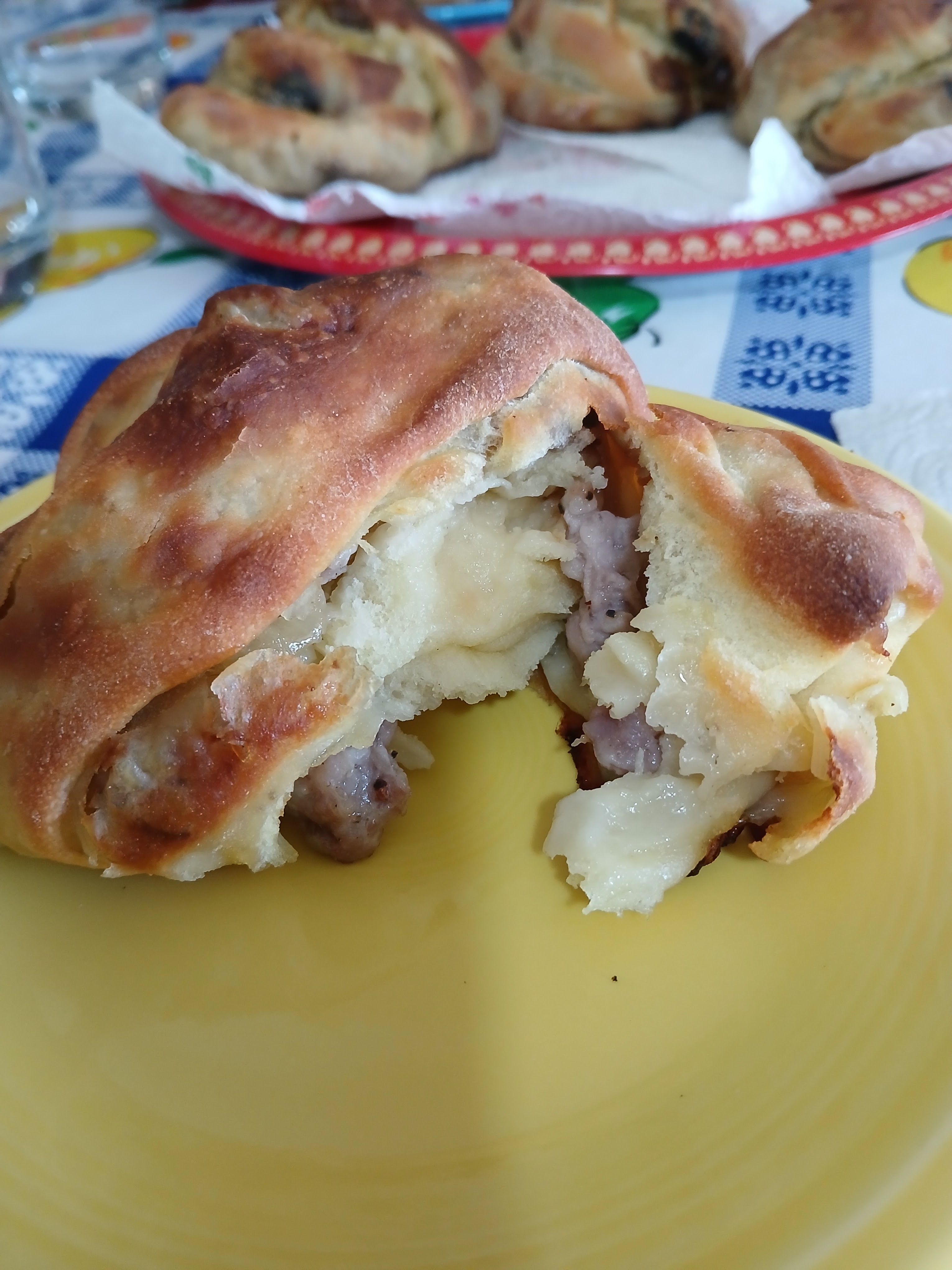
M’Briulati, (pronounced Mm-bree-uh-laah-tee) are a bread roll usually stuffed with sausage, oil cured olives, and onions. There are other variations, stuffed with other meats and vegetables, but our family makes the classic version.

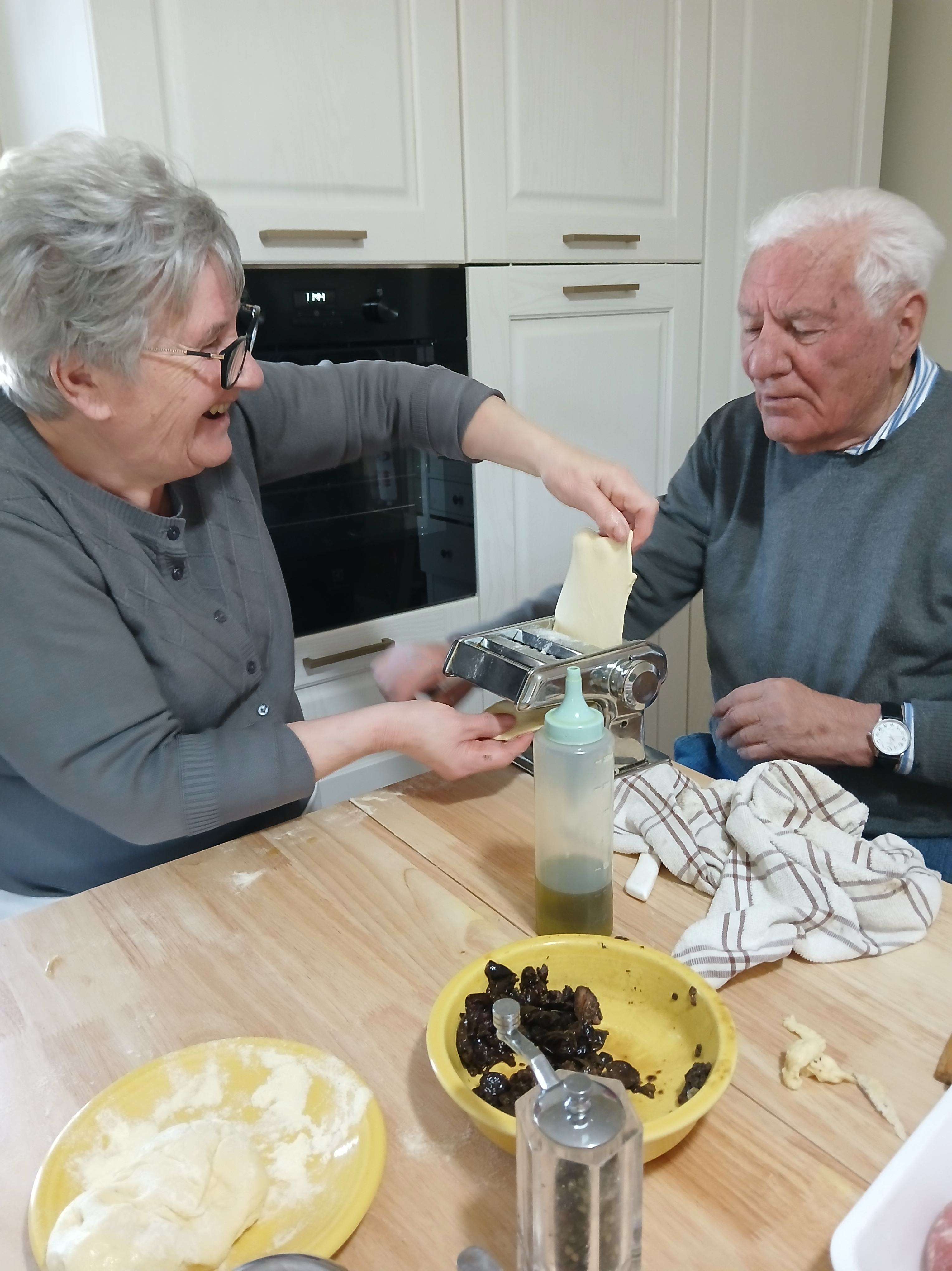
A couple of weeks ago, Rose and Angelo set up their M’Briulati assembly line at my house and I endeavored to document the process.

Ingredients:

  • Dough – Rose uses her pizza dough recipe.
  • Sausage – Rose uses sweet sausage from our local butcher.
  • Sauteed Onions – The onions are sliced thin and sauteed in olive oil over low heat until softened but not browned.
  • Pitted Passuluna – Oil cured olives from our trees. (See post dated November 1, 2024 for discussion and description of Passuluna.)
  • Olive Oil – Like the Olives, we are fortunate to have delicious Extra Virgin Olive Oil from our own land.
  • Salt and Pepper.

My mother rolled out the dough manually, a process that required both time and skill (see October 27, 2015 post for visual of manual rolling.) The process is much faster and easier by the use of a pasta machine to roll the dough.

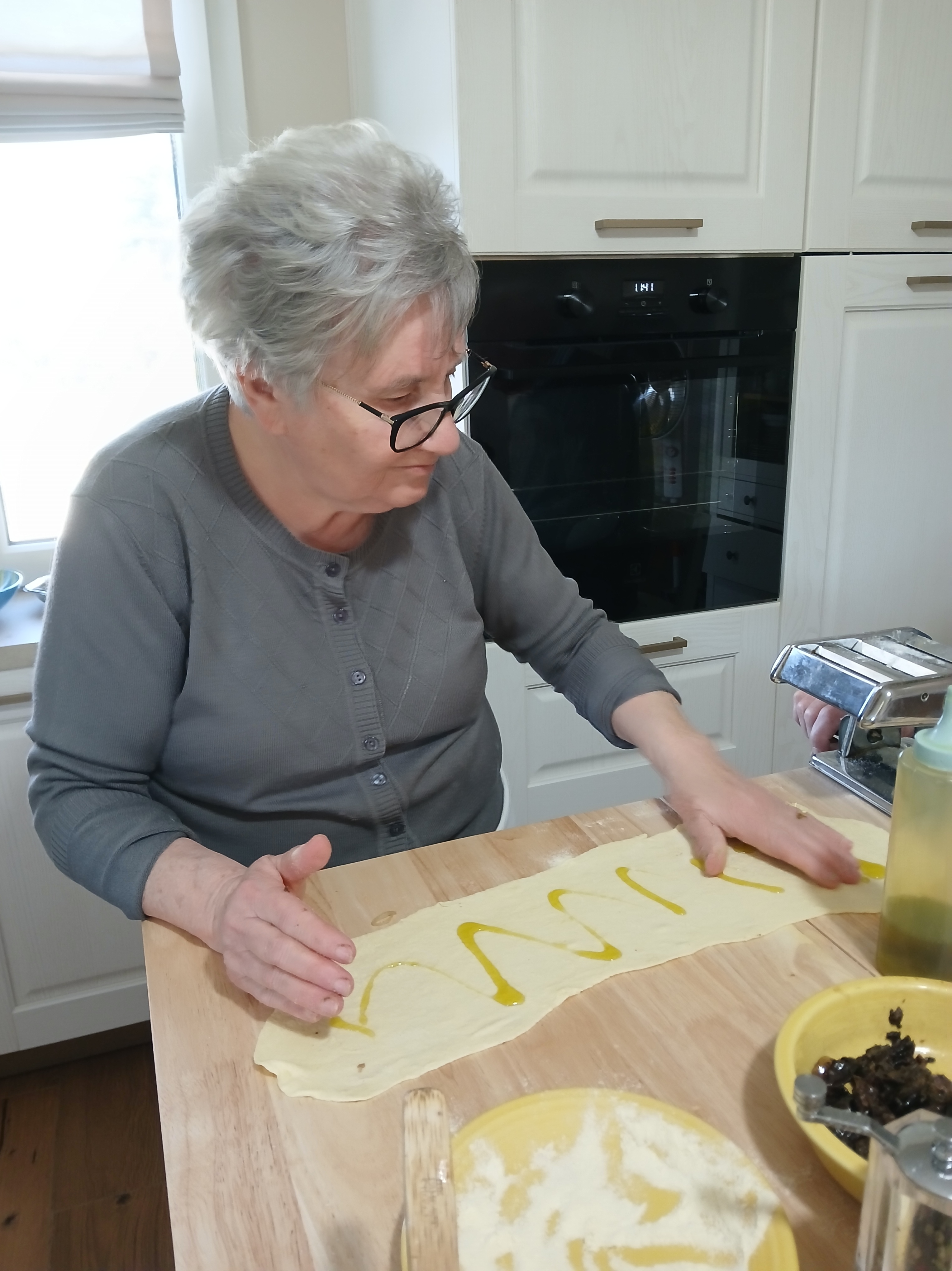
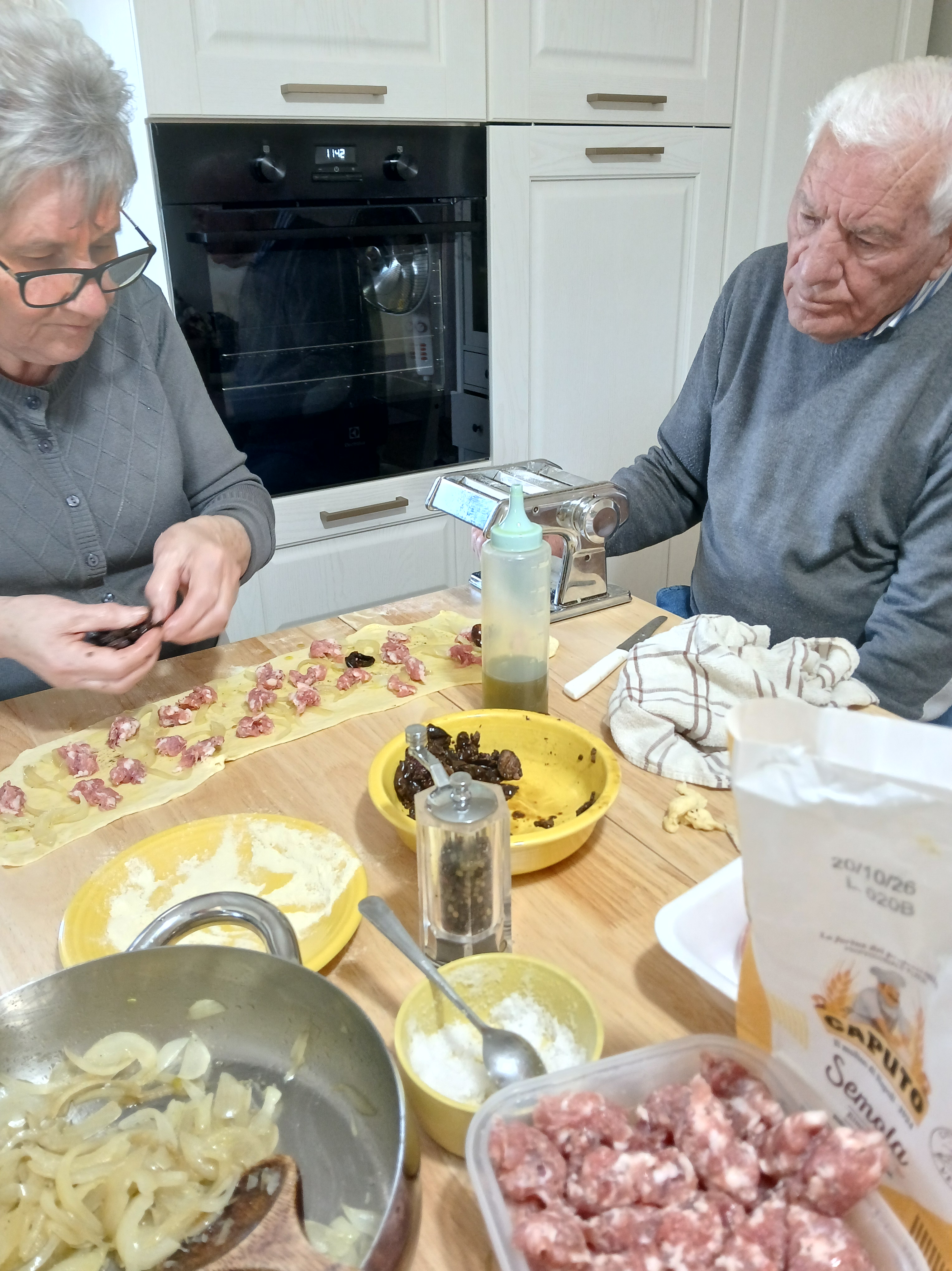
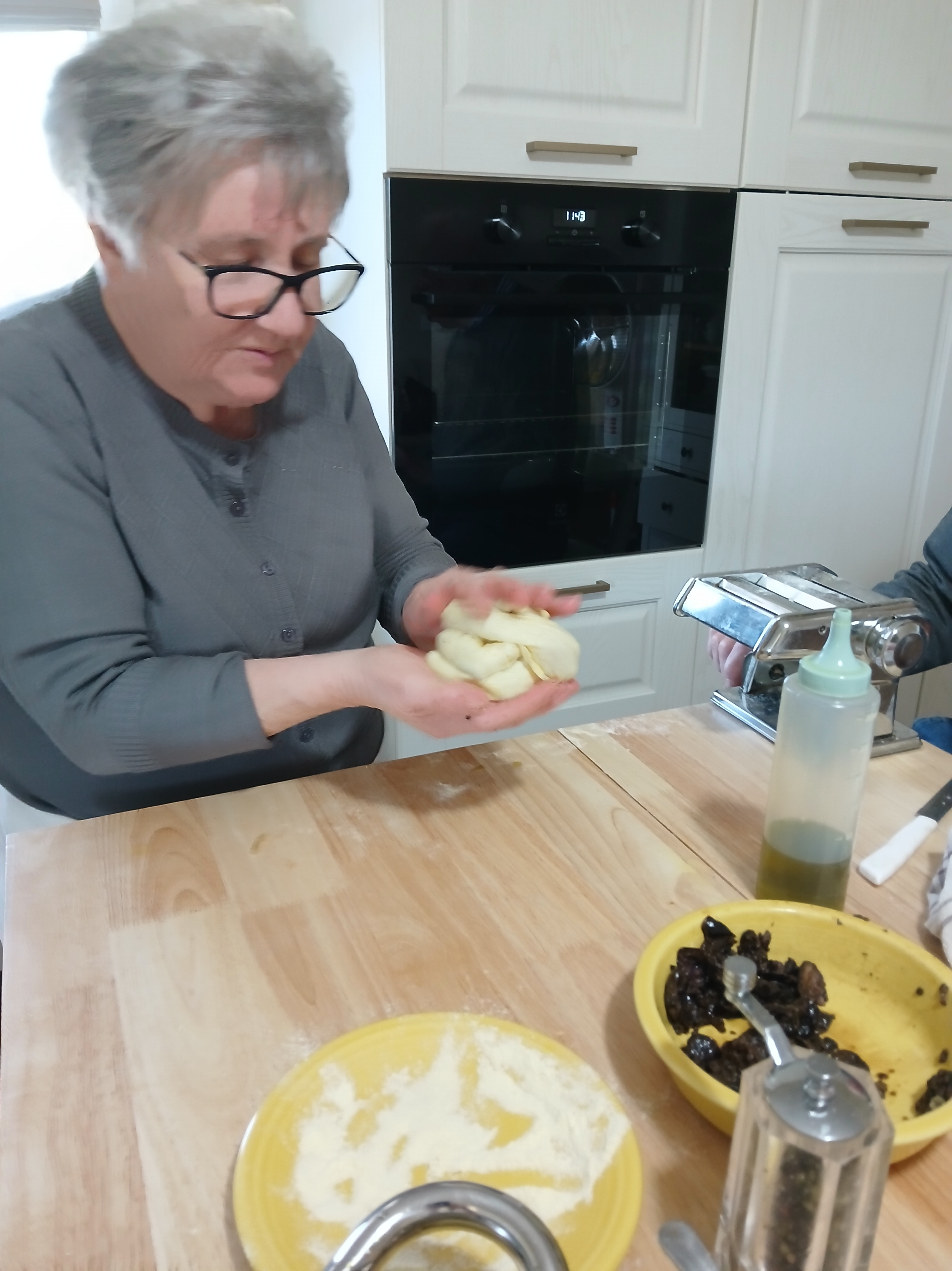
Rose and Angelo have developed their own assembly process:

  1. Angelo’s job is to turn the handle of the pasta machine.
  2. The dough is rolled to the thickness of Number Three (on the roller of my pasta machine.)
  3. The dough sheet comes out the width of the pasta machine.
  4. Rose widens the sheet by stretching horizontally.
  5. Rose adds salt and pepper and a thin layer of olive oil.
  6. Sausage, onions and olives are dotted on the dough.
  7. The seasoned dough is rolled into a log.
  8. The log is twisted into a loose ball and placed on a parchment lined baking pan.
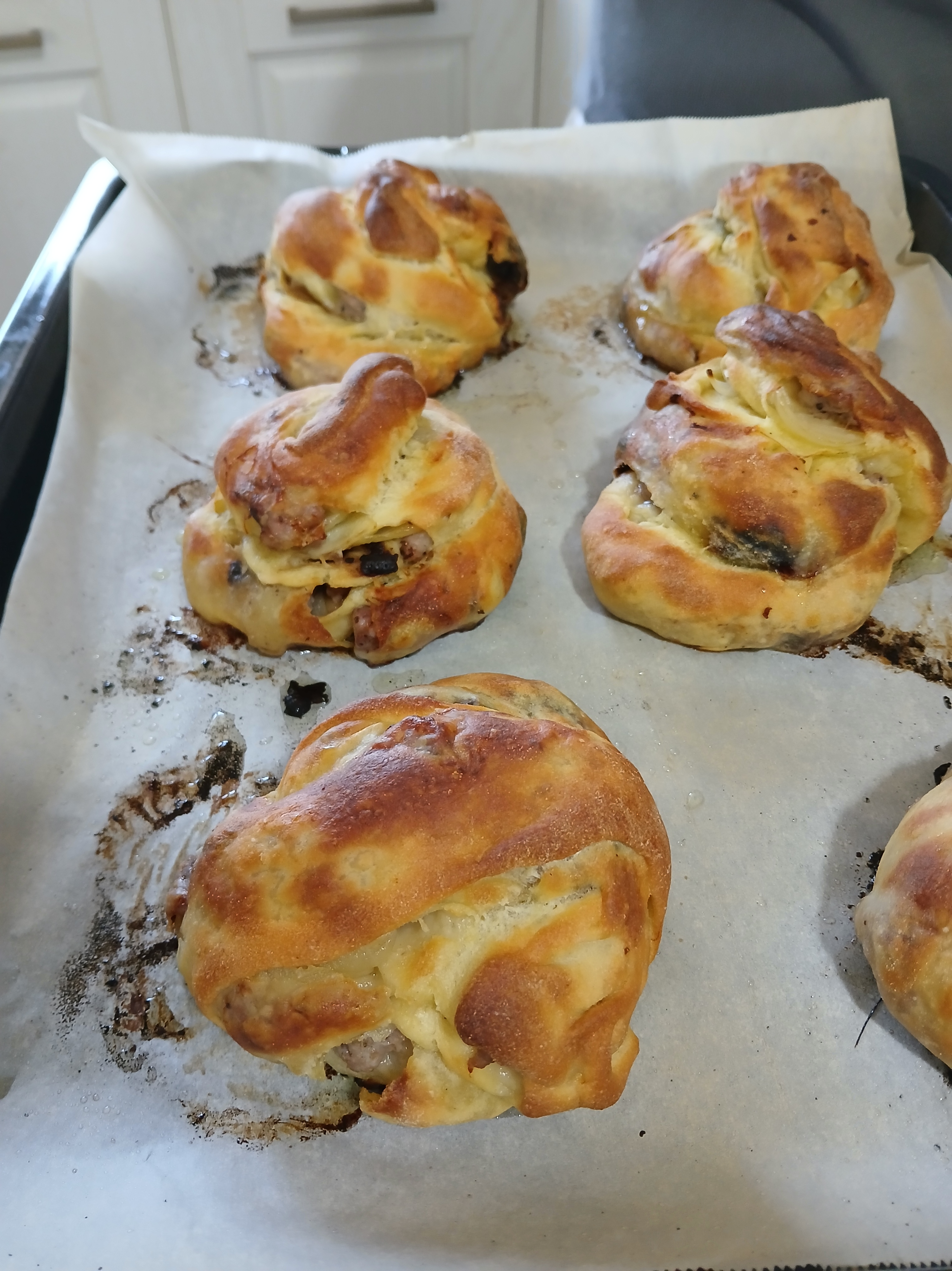
  9. The M’Briulati are baked at 250 degrees Celsius for approximately 25 minutes until golden brown.

Assembling M’Briulati
We enjoyed our M’Briulati fresh from the oven. As usual, they were wonderful!


M’Briulati Dough

  • 800 Grams Semola Rimacinata
  • 10-12 Grams Fresh Yeast
  • 1 Tablespoon Granulated Sugar
  • 250 ML Tepid Water, additional tepid water for kneading
  • 1 Tablespoon Olive Oil
  • 1 Teaspoon Salt

In a small bowl, combine 250 ML of tepid water and sugar. Add yeast and dissolve.

In a large bowl, combine flour and yeast mixture. Mix until incorporated, adding additional water to form a consistent dough. The amount varies depending upon type of flour, humidity etc. The objective is to develop a smooth dough.

Add salt to bottom of bowl with small amount of water and work in throroughly by kneading.

Add oil and continue kneading until smooth dough is formed.

Divide into 100 Gram balls and set aside to rise in a warm place. The dough is ready when it is light and fluffy.

When risen immediately roll and fill.

Makes approximately 12 M’Briulati.
Mennuli!

Almonds!

We completed our first Almond harvest a few weeks ago.

I have vague and happy memories of almond harvest as a very little girl. My memories are mostly about having fun and running around while my exteded family processed the crop for market. I recall everyone around a table talking and laughing while shelling almonds. Rose’s memories are more realistic and maybe not so much fun.

In my parents’ and grandparents’ time, Almonds were an important cash crop. A good harvest could provide income to maintain the family for an entire year. They worked very hard picking Almonds during the heat of the day and shelling and processing by lantern light at night.

The image below features: my maternal grandfather Pietro, my mother Lucia, my sister Rose holding my younger sister Nina while they are shelling Almonds. It is a little dark, but I love everything about it: the prickly pear cactus background, the wooden chairs, the pile of almonds, my grandfather in his cap, my mother’s natural beauty, and Rose smiling and lifting Nina up to the camera lens.


Arricampari Mennuli (Harvesting Almonds)

Arricampari (Pronounced Ah-rrii–cahmpa-rih) means “to bring home.”

We don’t have a lot of Almond trees at my house, and once again, it was not a great agricultural year. Due to the small scale of the harvest, Arricampari is done the same way my ancestors did it…by hand.

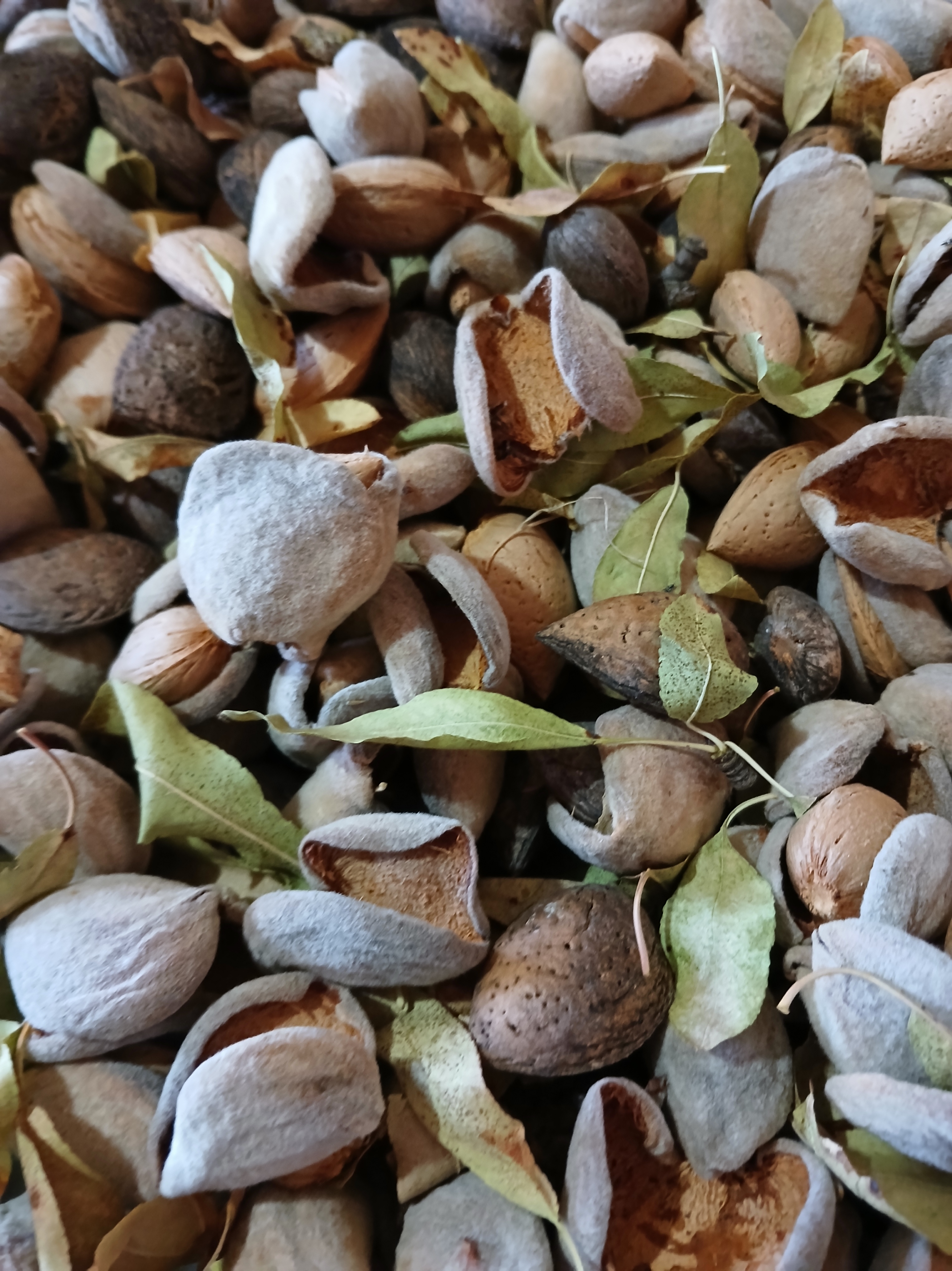
Almonds have a green outer hull and a hard inner shell covers the Almond kernel. They are ready to harvest when the hull dries and splits open, revealing the shell. As with the olive harvest, large nets are spread under the trees to catch the nuts.

Here are the steps:

  • Scutulari (Pronounced skuuh-tuuh-lahree) (Dropping the Almonds) The literal translation of Scutulari is “shaking.” Large agricultural concerns have machinery that shakes the tree trunk to release the ripe Almonds. At my house, Signor Raimondo used a wooden pole to strike the branches and knock the Almonds out of the trees and on to the nets. Signor Raimondo then gathered the Almonds and placed in sacks for processing.
  • Scricchiari (Pronounced skri-kkiah-ree)(Removing the hull) Rose and Angelo and I took over this step with sporadic assistance and supervision from Rose’s three year old granddaughter, Giorgia. Our task was to separate the nuts from the hulls. Most of the time, the Almonds naturally fall out of the hulls during the Scutulari step. In that case, it is a matter of sorting out the Almonds and discarding the hulls. Sometimes the hull clings stubbornly. It must be manually removed by striking with a blunt object like a stone or hammer. We set up piles of Almonds on the kitchen table and pounded, sorted and hulled over several afternoons.
  • Scacciari (pronounced skah-chiah-ree) Removing the shell. This is the hard part of Almond harvest. We have two varieties of Almonds. One is soft and easy to shell, the other has a much harder shell that requires some effort to remove. Below are the hard shell variety, the inside of the shell is pretty and smooth, but difficult to open. I am not very proficient at shelling, Rose is much better at it, but it is still difficult and time consuming. Angelo took pity on us and took over the Scacciari step for the hard shell variety. He retreated to the garage, cracked the Almonds with a mallet and brought us buckets of cracked Almonds to sort. Rose and I and Giorgia sorted the kernels and discarded the shells. Giorgia had a wonderful time and made the task much more entertaining. I hope her adult memories are of the fun she had shelling almonds with her Nonno (Grandfather) Nonna (Grandmother) and Zia (Aunt.)

The result of our Almond Harvest are a large container of shelled Almond kernels, and a sack of unshelled Almonds to process as needed. My plan is to try to grind some for Almond flour (a new activity for me…hope it works.) Will use some for baking and snacking and plan to sell some to a local vendor.

We trimmed the trees after the harvest and it has rained a bit. Hopefully the almond trees will thrive with the care they are receiving. Looking forward to Spring for Almond trees in flower.